
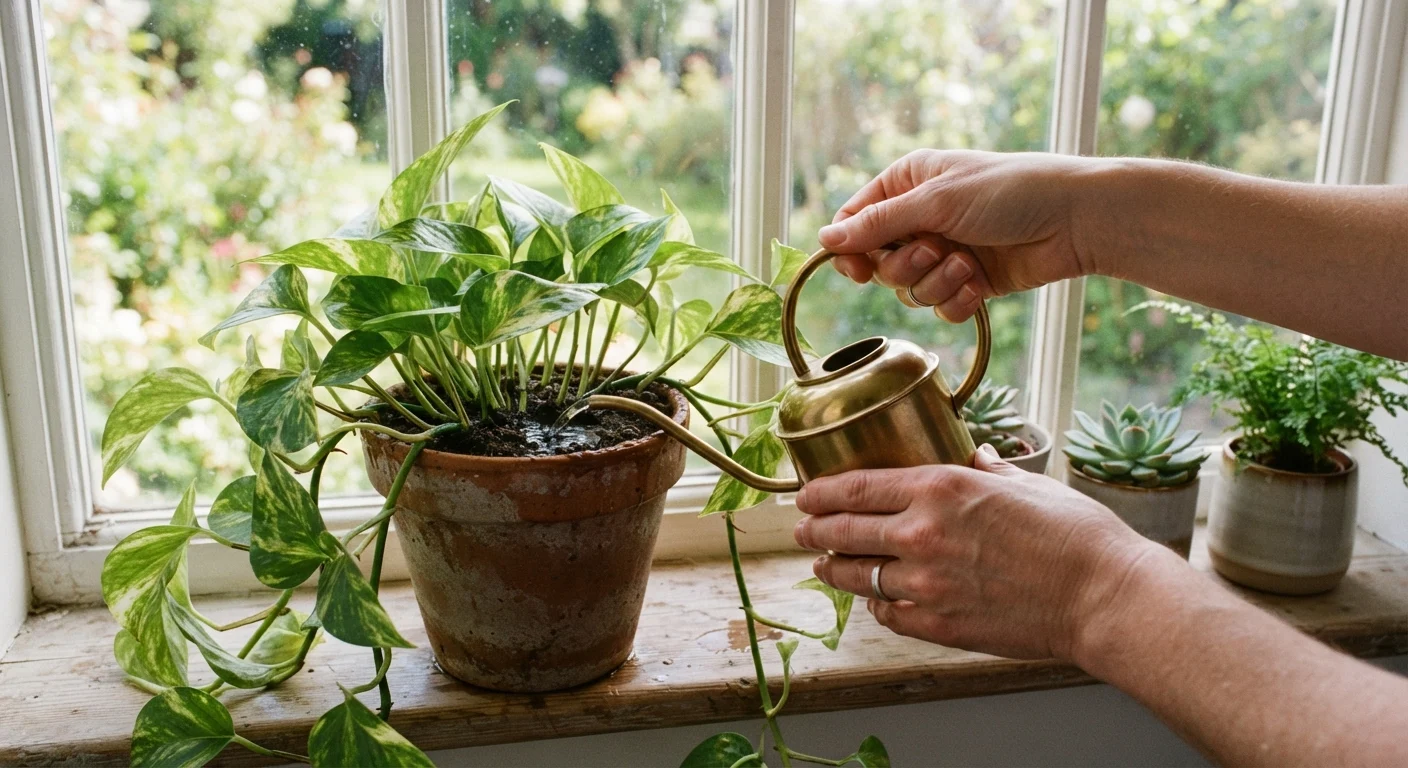

“Plants make you 15% more productive.” You’ve probably seen that line. It turns up in office design brochures, plant shop newsletters and a long list of wellness articles. Trace it back to the study it came from, though, and the call centre that was studied showed no change in productivity at all.
That’s a fair summary of the research on indoor plants and wellbeing as a whole. Some of what you’ve heard holds up. Some of it was stretched well past what the studies found. And looking after a plant, which seems to matter most, gets talked about least.
Why green things feel good to us
In 1984 the biologist E.O. Wilson proposed what he called biophilia: the idea that humans have an inborn pull toward other living things, shaped by the long stretch of our history spent outdoors (Wilson 1984). It’s an appealing idea and a reasonable one. It’s also still a hypothesis.
Psychologists Rachel and Stephen Kaplan offered another explanation. Their Attention Restoration Theory suggests that natural scenes let our tired, effortful attention rest and recover (Kaplan 1995). Most of the support for it comes from time spent in real outdoor nature, and reviews have found effects on only some of the attention measures tested (Ohly et al. 2016). Applying it to a pot on your desk is a leap.
Ayurveda sees it differently. Living plants are traditionally thought to bring prana, the life force, into a home. Science hasn’t tested that idea, but it points at something the research keeps coming back to: a plant is alive, and looking after it seems to be part of the point.
What research on indoor plants and wellbeing consistently finds
The most reliable finding is the obvious one: people feel better around plants. A 2019 review of 50 studies found the clearest effects were more positive emotions and fewer negative ones, though most of those studies were of moderate quality (Han & Ruan 2019).
Workplace research says much the same. A large field study across nine Dutch organisations found that adding plants made people rate their workspace as more attractive and more satisfying, and cut complaints about dry air (de Vries et al. 2023).
Home data points the same way, with a catch. During the COVID-19 lockdowns, a survey of 4,205 people found that those with indoor plants reported more positive emotions (Pérez-Urrestarazu et al. 2021). But people with plants also tended to have larger, brighter homes, and the same survey linked negative feelings to small, dark ones. So it’s hard to say how much of the lift came from the plants.
Feeling better in your own room every day is worth something. Plenty of plant articles present it as a measurable health effect, though, and the studies don’t show that.
Where the evidence gets thin
Once researchers measure things objectively, the benefits of houseplants shrink or disappear.
A 2022 meta-analysis pooled the experimental studies on indoor plants and physical or mental performance (Han et al. 2022). It found no significant effect on attention, reaction time or brain-wave activity. It did find a link with lower diastolic blood pressure, but that rested on three studies that disagreed sharply with each other, so the size of the effect is almost certainly overstated. The authors rated the average study quality at 45%.
The Dutch workplace study measured a lot of things. Plants made no measurable difference to 13 of its 18 outcomes, including mental health, sick days and job satisfaction (de Vries et al. 2023).
For mental health in ordinary homes, there’s very little to go on. A 2023 review sifted through 1,186 search results and found only six studies that qualified (Zhao et al. 2023). All six were one-off snapshots, five of them from COVID-era homes, and the authors called the evidence “currently limited”.
| Claim | What the studies show | Strength of evidence |
|---|---|---|
| Plants lift your mood | More positive and fewer negative feelings across many small studies | Fairly consistent, moderate quality |
| Rooms with plants feel nicer | People rate them as more attractive and satisfying | Consistent |
| Plants improve focus | No significant effect on attention in the 2022 meta-analysis | Weak |
| Plants lower blood pressure | Linked in only three inconsistent studies | Weak |
| Plants improve mental health | Only six snapshot studies exist | Very limited |
| Caring for plants eases low mood | Positive in therapy programmes and one small home trial | Promising, low certainty |
| Plants clean the air | You’d need 10–1,000 plants per square metre | Not supported |
Three famous plant claims, checked
“Plants make you 15% more productive”
This comes from a 2014 paper by Nieuwenhuis and colleagues (Nieuwenhuis et al. 2014). The 15% figure appears in the paper’s discussion, without the calculation behind it. The study’s only significant objective result came from a single task, crossing out letters on a page, done by 33 people. In the Dutch call centre that was also studied, the company’s own productivity measure showed no plant effect. The research was part-funded by the Dutch horticulture board and a plant company, and the 15% has travelled much further than the evidence behind it.
“Plants help hospital patients recover”
Park and Mattson randomly gave about 90 surgical patients rooms with or without plants (Park & Mattson 2009). The patients with plants rated their pain, anxiety and tiredness lower, and their systolic blood pressure was lower too.
Those results are real, but the patients could see whether they had plants, most of the outcomes were self-rated, and many said the plants made the staff seem more caring, which could explain part of the effect. You’ll often read that these patients needed fewer painkillers and went home sooner. The published abstract doesn’t report a significant effect on either.
“Repotting a plant lowers stress”
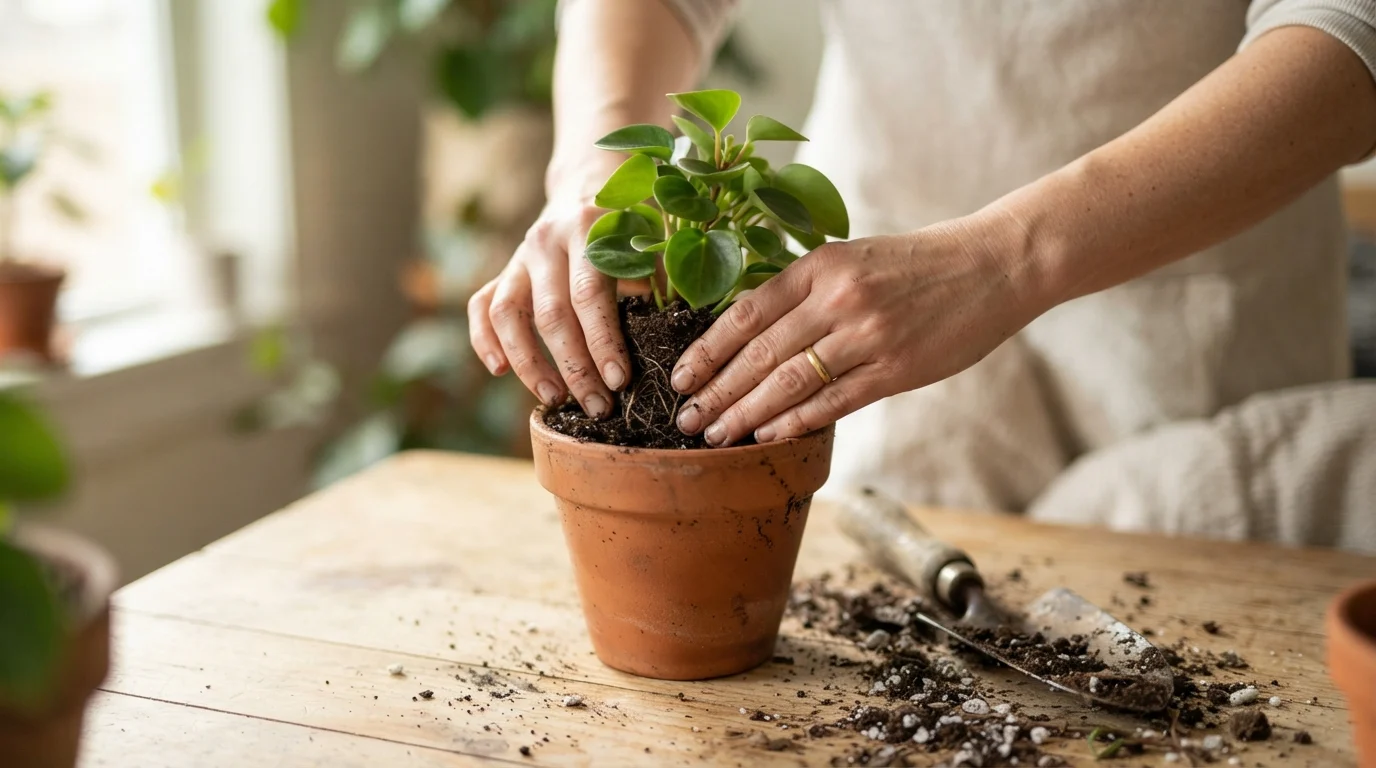
In this 2015 study, 24 healthy young men spent 15 minutes repotting a plant and, on another occasion, 15 minutes on a computer task (Lee et al. 2015). They said they felt more comfortable and soothed after repotting. The heart-rate measure of stress only differed in the final three minutes, a window the authors chose after seeing the data. And the comparison was a mildly stressful task, not a calm room without a plant.
Small studies like these are a reasonable place for research to start, but they can’t support the confident headlines built on them.
Do houseplants clean the air?
Not in any amount you’d notice.
The idea comes from NASA research in the late 1980s, which tested plants inside small sealed chambers of under one cubic metre, with no fresh air coming in, for possible use on space stations (NASA 1989). A living room is nothing like that. The air in a home is replaced all the time through doors, windows and gaps.
In 2020, researchers Cummings and Waring took the results from 12 of those chamber studies and converted them into the measure used to rate air purifiers (Cummings & Waring 2020). The typical potted plant cleaned about 0.023 cubic metres of air per hour. To match ordinary building ventilation, you’d need somewhere between 10 and 1,000 plants for every square metre of floor.
The US Environmental Protection Agency is blunt about it: there’s no evidence that a reasonable number of houseplants removes significant amounts of pollution in homes and offices (US EPA). It recommends removing the sources of pollution first, then ventilating, then using an air cleaner if needed.
So open a window for fresh air, and grow plants for everything else.
Caring for plants has the strongest evidence
Horticultural therapy, where trained therapists run structured gardening programmes, shows the clearest benefits. A 2026 meta-analysis of 13 randomised trials in people with depressive disorders found a large improvement in depression scores (Li et al. 2026). A 2024 review of seven trials in older adults with depression found a moderate one (Giang et al. 2024).
The certainty is mostly low. The studies are small, participants knew which group they were in, and most programmes run in groups, often outdoors, so company, movement and routine come bundled in with the plants.
Closer to home, a 2025 pilot study asked 26 people who had recently been through a stressful life event to care for a ZZ plant for a month, while a comparison group waited (Azad & Marselle 2025). The plant group reported fewer depressive symptoms and less stress. It’s a tiny study, and expectation could explain some of it, but it’s the first trial of a single houseplant cared for at home.
Caring may matter because of the routine. Watering, checking the soil and turning the pot toward the light take a few minutes of unhurried attention, which is close to what many simple mindfulness practices ask of you, and the plant gives you a reason to keep doing it.
A plant isn’t a treatment. If you’re dealing with low mood or anxiety, it can be a pleasant part of your day, alongside proper support rather than instead of it.
Keep the plant alive, or lose the benefit
A plant that’s slowly dying doesn’t calm anyone down. It becomes a small daily reminder that something isn’t working.
University of Georgia Extension names low light and overwatering as the most common causes of stress in indoor plants (UGA Extension). The two are linked. A plant in a dim spot uses water slowly, so it sits in wet soil until the roots rot.
Light is also hard to judge by eye. Our eyes adjust so well that a corner can look bright to us while getting a small fraction of the light at the window. As a rough guide, even tough low-light plants need somewhere around 800–2,000 lux to grow well rather than just survive (UGA Extension).
The simplest fix is to measure before you buy. LumiLeaf turns your phone into a basic plant light meter: hold it where the leaves will sit, and it tells you whether the spot gets low, medium or bright light and which plants suit it. We make LumiLeaf ourselves, so we’re biased, but it costs nothing to try. Phone sensors aren’t lab instruments, but they’re good enough to compare spots and tell a dim corner from a bright one.
Five forgiving plants to start with
If you’re new to houseplants, start with something hard to kill. All five of these cope with lower light than most, and all of them prefer to dry out a little between waterings.
| Plant | Light | Watering | Safe for cats and dogs? |
|---|---|---|---|
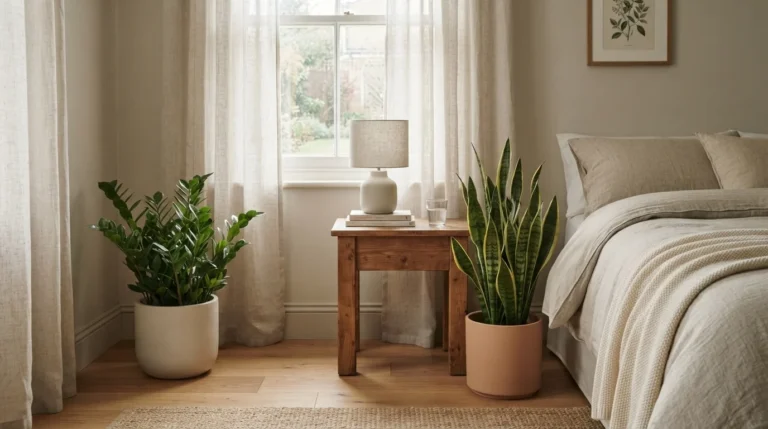
| Snake plant (Dracaena trifasciata, formerly Sansevieria) | Low to bright | Every 1–2 months in winter | No (ASPCA) |
| ZZ plant (Zamioculcas zamiifolia) | Copes with deep shade and office lighting | About monthly in winter | No (NC State Extension) |
| Pothos (Epipremnum aureum) | Low to bright, grows faster with more | When the top of the soil is dry | No (ASPCA) |
| Cast iron plant (Aspidistra elatior) | Low to medium | When the top of the soil is dry | Yes (ASPCA) |
| Parlor palm (Chamaedorea elegans) | Low to medium | When the top of the soil is dry | Yes (ASPCA) |
The snake plant and ZZ plant are the toughest of the group, and both rot if you water them too often (NC State Extension). If you share your home with a cat or dog, the cast iron plant and parlor palm are the safe choices.
Where to start
Start with one plant. Check the spot before you buy, choose something suited to the light you actually have, and give it a few minutes of attention each week. That’s the version of indoor plants and wellbeing the research supports best: a living thing you look after, in a spot with enough light for it to thrive.
FAQ
Do indoor plants improve mental health?
People consistently say they feel better around plants, and caring for plants shows promise in small studies and therapy programmes. There’s little evidence that houseplants on their own improve mental health in a measurable way, and they’re no substitute for professional support.
How many plants do you need?
There’s no proven number. One early study using computer-generated rooms found that greenery filling about a fifth of the view felt most restful, and that much more than that started to raise stress (Stanford Engineering 2025). A few healthy plants you actually look at and look after is a sensible place to start.
Do houseplants purify the air?
Not in any meaningful way. You’d need roughly 10 to 1,000 plants per square metre to match normal ventilation, and the US EPA says there’s no evidence a reasonable number of houseplants removes significant pollution. Opening a window does far more.
Sources
- Azad & Marselle (2025). Pilot trial of caring for a houseplant after a stressful life event. International Journal of Environmental Research and Public Health. https://doi.org/10.3390/ijerph22030369
- Cummings & Waring (2020). Potted plants do not improve indoor air quality: a review and analysis of reported VOC removal efficiencies. Journal of Exposure Science & Environmental Epidemiology. https://doi.org/10.1038/s41370-019-0175-9
- de Vries et al. (2023). Field study of indoor plants in nine Dutch organisations. Frontiers in Psychology. https://doi.org/10.3389/fpsyg.2023.1196106
- Giang et al. (2024). Review of horticultural therapy for older adults with depression. Journal of the American Medical Directors Association. https://doi.org/10.1016/j.jamda.2024.105296
- Han & Ruan (2019). Review of 50 studies on indoor plants and self-reported feelings. Sustainability. https://doi.org/10.3390/su11164506
- Han, Ruan & Liao (2022). Meta-analysis of indoor plants and objective human outcomes. International Journal of Environmental Research and Public Health. https://doi.org/10.3390/ijerph19127454
- Kaplan (1995). The restorative benefits of nature: toward an integrative framework. Journal of Environmental Psychology. https://doi.org/10.1016/0272-4944(95)90001-2
- Lee, Lee, Park & Miyazaki (2015). Interaction with indoor plants may reduce psychological and physiological stress by suppressing autonomic nervous system activity in young adults. Journal of Physiological Anthropology. https://doi.org/10.1186/s40101-015-0060-8
- Li et al. (2026). Meta-analysis of horticultural therapy for depressive disorders. Frontiers in Public Health. https://doi.org/10.3389/fpubh.2026.1824111
- NASA (1989). Wolverton, Johnson & Bounds, Interior landscape plants for indoor air pollution abatement. NASA Technical Reports Server. https://ntrs.nasa.gov/citations/19930072988
- Nieuwenhuis, Knight, Postmes & Haslam (2014). The relative benefits of green versus lean office space: three field experiments. Journal of Experimental Psychology: Applied. https://doi.org/10.1037/xap0000024
- Ohly et al. (2016). Systematic review of attention restoration in natural environments. Journal of Toxicology and Environmental Health, Part B. https://doi.org/10.1080/10937404.2016.1196155
- Park & Mattson (2009). Randomised trial of plants in hospital rooms after surgery. PubMed record. https://pubmed.ncbi.nlm.nih.gov/19715461/
- Pérez-Urrestarazu et al. (2021). Survey of 4,205 people on indoor plants during the COVID-19 lockdown. Urban Forestry & Urban Greening. https://doi.org/10.1016/j.ufug.2020.126919
- Stanford Engineering (2025). What’s the right amount of indoor nature? https://engineering.stanford.edu/news/whats-right-amount-indoor-nature
- Wilson, E.O. (1984). Biophilia. Harvard University Press. https://www.hup.harvard.edu/books/9780674074422
- Zhao et al. (2023). Scoping review of houseplants and mental health. Environmental Research. https://doi.org/10.1016/j.envres.2022.114715
- ASPCA. Toxic and non-toxic plants database. https://www.aspca.org/pet-care/animal-poison-control/toxic-and-non-toxic-plants
- NC State Extension Plant Toolbox: snake plant (https://plants.ces.ncsu.edu/plants/dracaena-trifasciata/) and ZZ plant (https://plants.ces.ncsu.edu/plants/zamioculcas-zamiifolia/)
- University of Georgia Extension. Bulletin B1318, Growing indoor plants with success. https://fieldreport.caes.uga.edu/publications/B1318/growing-indoor-plants-with-success
- US EPA. Improving indoor air quality. https://www.epa.gov/indoor-air-quality-iaq/improving-indoor-air-quality