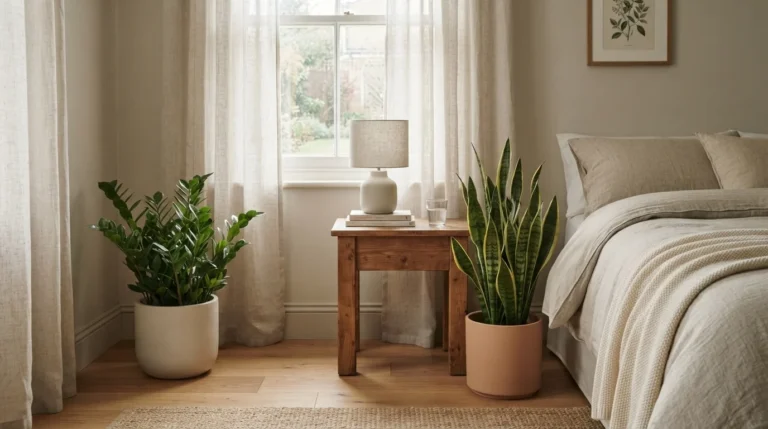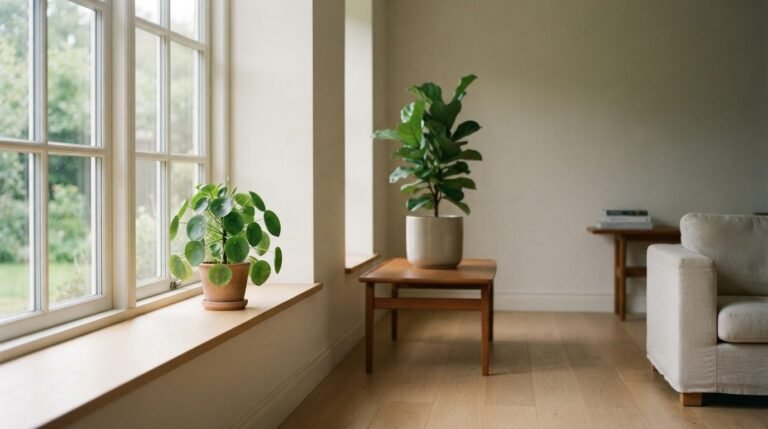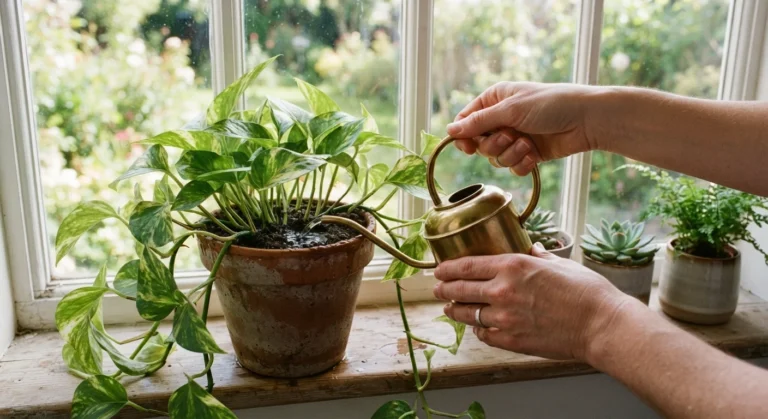

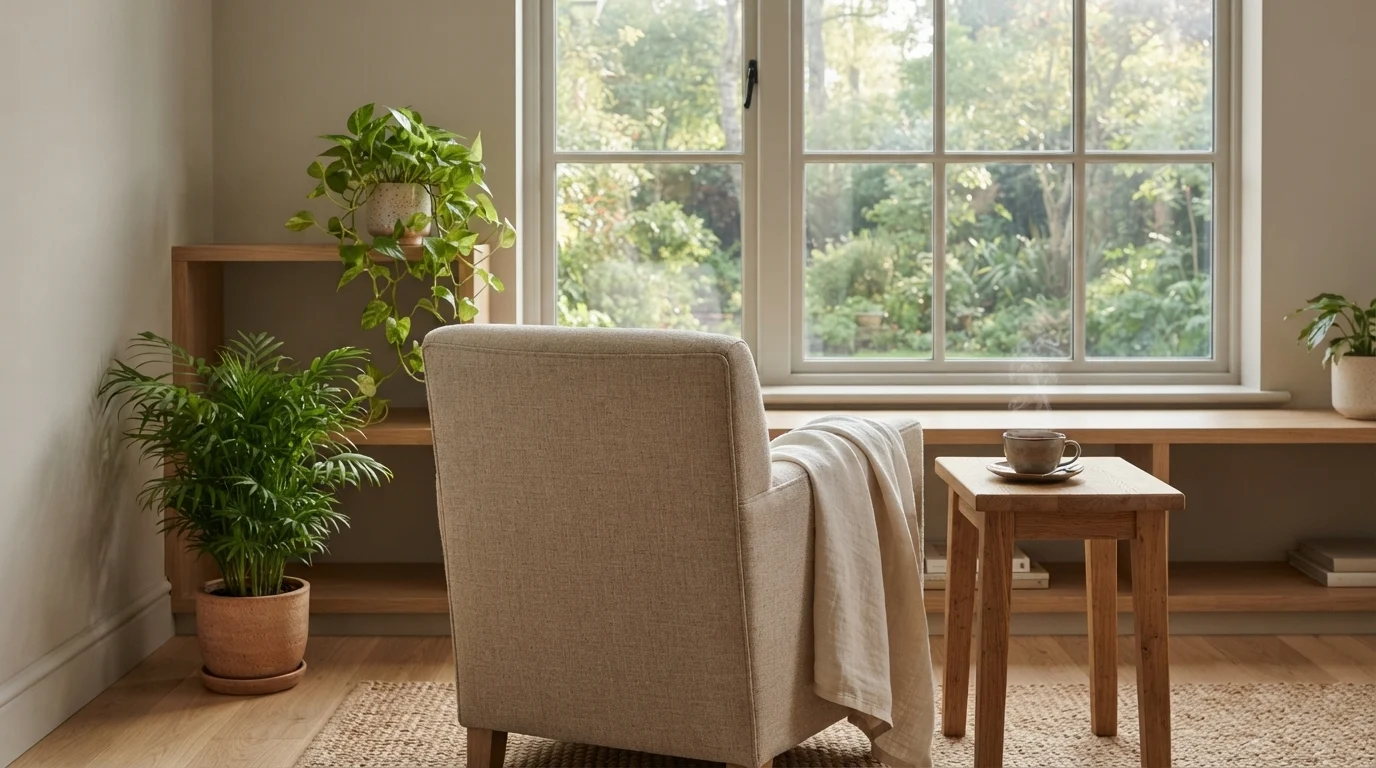

A chair by a window, a cup of tea going cold beside you, and two or three plants you actually look at. That’s most of what a calming plant corner needs. You don’t need many plants or a big budget, and the research behind the idea is modest but real.
Why a plant corner can help
People consistently say they feel better around plants, and looking after plants has the most promising evidence of all, as we covered in indoor plants and wellbeing. A corner built around a few plants puts both of those in one place you’ll actually use.
The study closest to the idea comes from Japan. Sixty-three office workers kept a small plant by their computer screen and, during three-minute breaks, simply looked at it. Their anxiety scores fell over the course of the study (Toyoda et al. 2020). There was no comparison group without plants, so treat it as an encouraging early result rather than proof. The set-up is worth copying, though: the workers didn’t just have a plant nearby, they stopped and looked at it.
Some things haven’t been studied at all. Nobody has tested whether plants in a meditation or yoga space deepen your practice. Your corner can be a good place to sit still. We just won’t promise it’ll make you a better meditator.
Choose the spot for your calming plant corner
The spot decides which plants will thrive there, and a struggling plant is the opposite of calming. Check how much light it gets before you buy anything. Our guide to how much light indoor plants need explains the numbers, and LumiLeaf will measure a spot with your phone and tell you which plants suit it. It’s an app we make ourselves, and it’s free on Android.
Biophilic design, the practice of bringing natural elements into buildings, offers a useful idea here. Terrapin Bright Green’s widely used framework describes 14 patterns, and two of them suit a corner well: refuge, a sheltered spot where your back is covered, and prospect, an open view out (Terrapin Bright Green). A chair angled into a corner, facing a window, gives you both.
The same framework values “dynamic and diffuse light”, the soft, shifting daylight you get near a window as clouds pass and the sun moves. That’s one more reason not to tuck your corner into the darkest part of the room, however cosy it looks.
How many plants for relaxation?
Fewer than you might think. In a 2025 Stanford study, 412 people viewed computer-generated rooms with different amounts of greenery. Rooms where plants filled about 20% of the view were the most restorative. Rooms packed with about 60% greenery plus wood produced the biggest rise in stress (Stanford Engineering).
The rooms weren’t real and the study is new, so don’t take 20% as a rule. It fits common sense, though. A few healthy plants you can see properly will feel calmer than a wall of leaves you can’t keep up with. Even a small amount of greenery seems to help, according to a 2022 review of the research (Gu et al. 2022).
Grouping your plants has a practical bonus in a dry room. In a 2024 study, adding Boston ferns to offices raised median humidity from about 29% with no plants to 39% with five and 49% with eighteen, without changing carbon dioxide or temperature (Jiang et al. 2024). You won’t fit eighteen ferns into a corner, but a small cluster does more than a single pot.
Choosing plants for your corner
Start with the light you measured. For a dimmer corner, the ZZ plant, snake plant, cast iron plant and parlor palm all cope well, and our guide to low light indoor plants covers more. A bright corner near a window opens up far more choice.
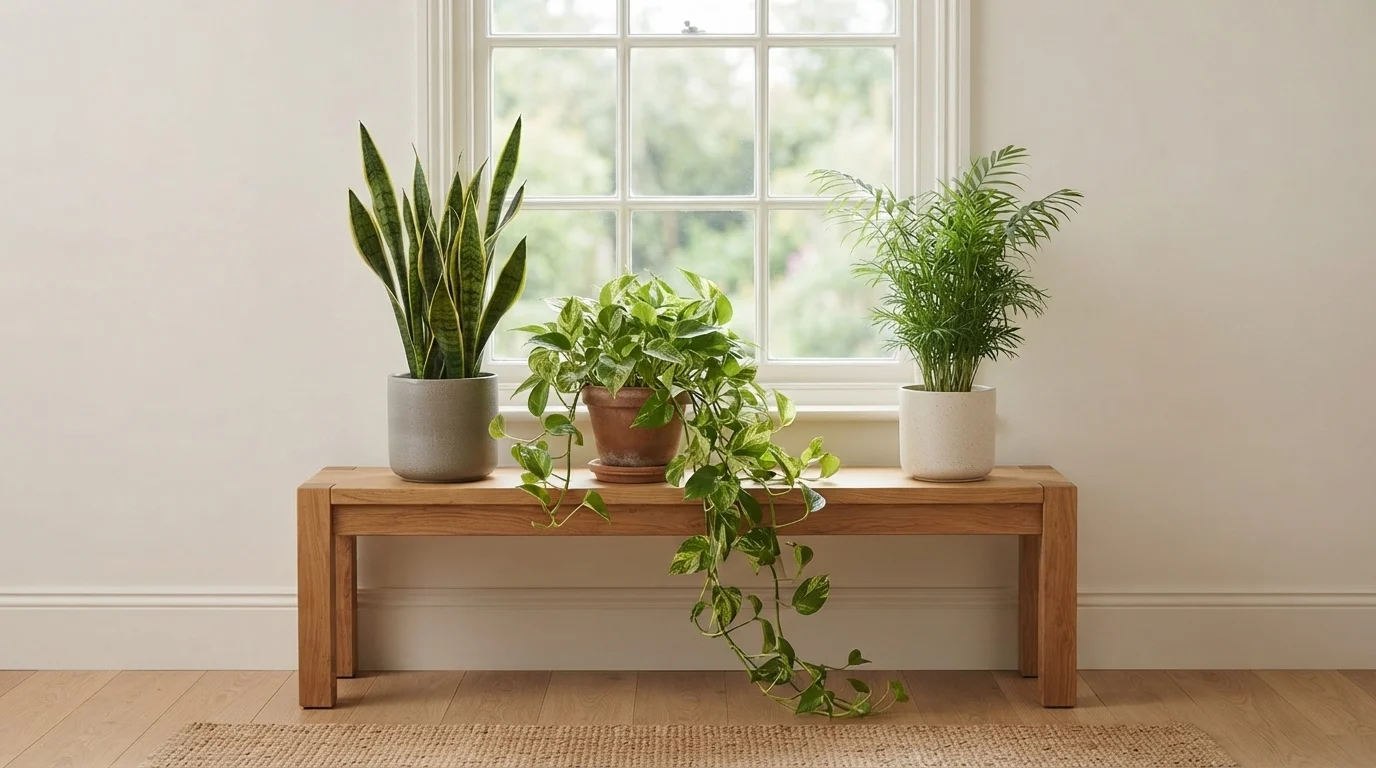
Then think about shape. Biophilic design talks about “biomorphic forms”, the curves and patterns found in nature, and a mix of plant shapes gives you that without trying. An upright snake plant, a pothos trailing from a shelf and the soft fronds of a parlor palm look very different side by side, and the variety gives your eye somewhere to rest.
If you have cats or dogs, the cast iron plant and parlor palm are the safe low-light choices, as both are listed as non-toxic by the ASPCA (ASPCA). Pothos, snake plant and ZZ are toxic to pets, so keep them out of reach or leave them out.
Include at least one plant you’ll enjoy looking after, such as a herb you can pinch or a plant whose new leaves you’ll notice.
Three plant corner ideas to copy
Each set-up uses the light bands we use across this series, so measure your spot first.
A bright window nook
If your spot reads medium to bright indirect light, roughly 2,500 to 20,000 lux, you have the most choice. Put a pothos on a shelf where it can trail, a peace lily on the floor (it likes evenly moist soil, so it’s the one to water most often), and a pot of herbs on the sill if it gets a few hours of direct sun. A wooden stool and a linen cushion finish it off.
A dim living-room corner
For a corner in the low-light band, 500 to 2,500 lux, rely on the toughest plants: a ZZ plant on the floor, a cast iron plant beside it, and a heartleaf philodendron trailing from a shelf above. Water all three sparingly. If you’d like more growth, a small LED grow light on a timer makes a real difference.
A pet-friendly corner
With cats or dogs around, build the corner from non-toxic plants. In low light, that means a cast iron plant and a parlor palm. If the spot is brighter, add a spider plant or a Boston fern, which are also non-toxic to pets according to the ASPCA but need medium light to do well (ASPCA).
Natural materials and your other senses
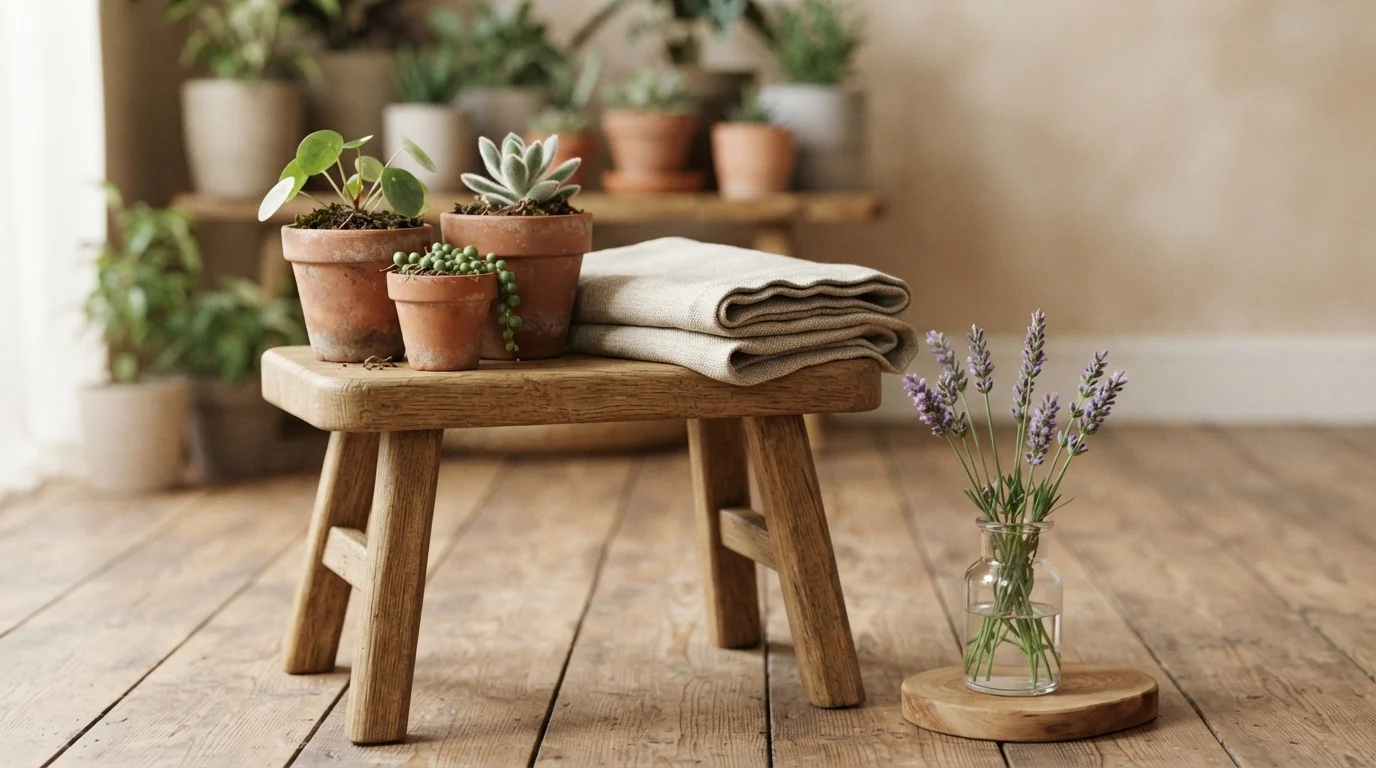
The Terrapin framework includes a pattern called “material connection with nature”: wood, stone, clay, linen and other natural materials. A wooden stool, terracotta pots and a cotton throw fit that idea easily and cost very little.
The direct evidence for materials is thinner than the design advice suggests. Small studies, mostly from one research group in Japan, found that touching wood was more relaxing than touching metal or tile (Ikei et al. 2017). In the Stanford study, wood on its own made no difference. Choose natural materials because you like them, and treat any calming effect as a bonus.
Scent works the same way. A 2019 review found that inhaling lavender reduced anxiety scores, but the authors rated the trials behind it as low quality (Donelli et al. 2019). If you love the smell, a little lavender in your corner is a nice touch. If you don’t, skip it.
Make tending part of the ritual
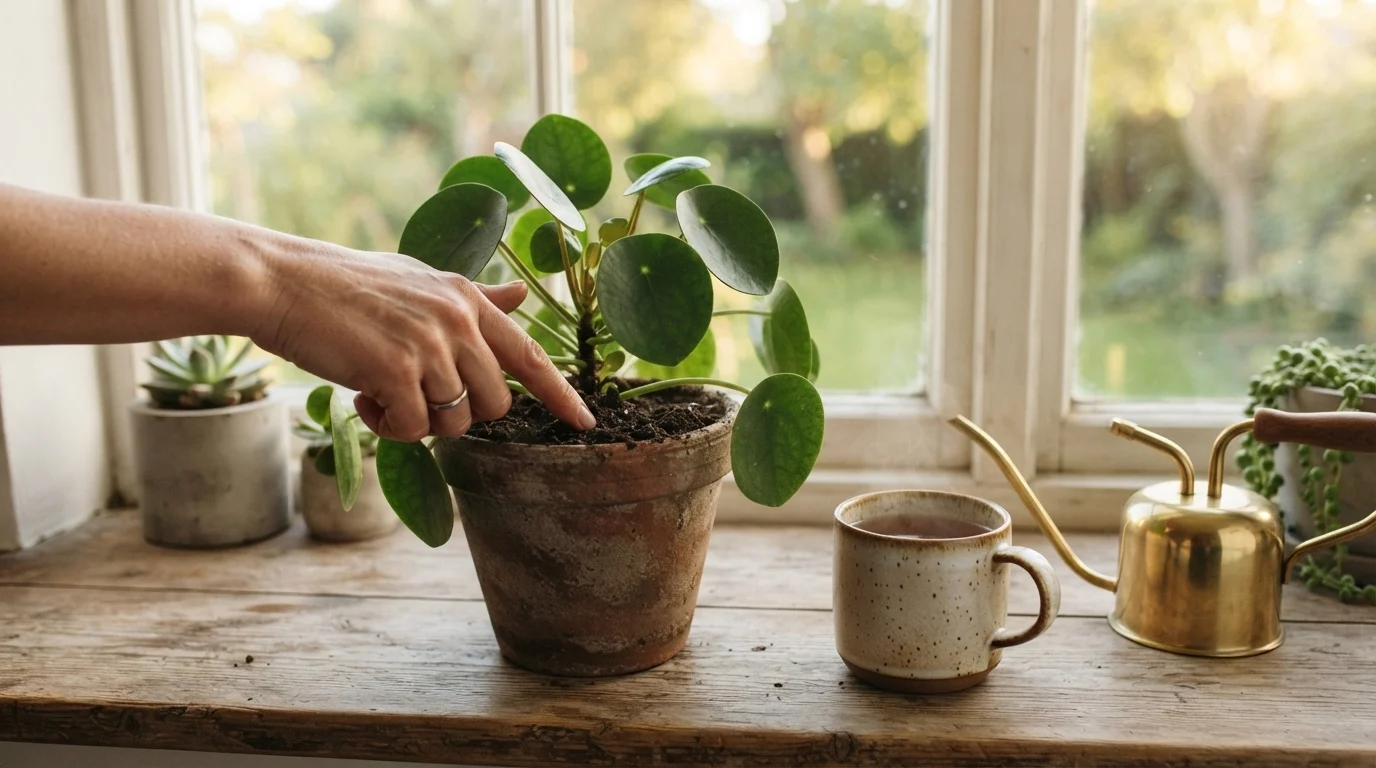
Caring for the plants is part of what makes the corner work. In one small study, 24 young men found repotting a plant more relaxing than a computer task (Lee et al. 2015). Another small study found that handling real flowers was more relaxing than handling artificial ones (Journal of Physiological Anthropology, 2013). Neither study is large enough to lean on heavily, but they point the same way as the wider research on gardening.
A simple weekly routine is enough. Check the soil with a finger before you water. Turn each pot a quarter turn so the plants grow evenly toward the light. Notice what’s new. It takes ten minutes, and it gives you a reason to sit down in the corner even on a busy day.
If you’d like to add a short practice while you’re there, our guides to pranayama breathing and meditation and prana are good places to start.
Mistakes to avoid
Overwatering is the big one. Besides rotting roots, constantly damp soil can grow microorganisms that bother people with allergies, which is one reason the US EPA advises against overwatering houseplants (US EPA).
Too many plants cause trouble too. More pots means more watering, more dropped leaves and more to feel guilty about when life gets busy. Start with two or three and add slowly.
The other common mistake is choosing the darkest corner because it feels snug. You can make a dim corner work with the right plants or a small grow light, but a spot near a window is easier on both you and the plants.
Start small
One chair, one window and two or three plants you like are enough to begin. Give the corner a few minutes most days and a little care each week, and let it grow from there.
FAQ
How many plants should a calming corner have?
Start with two or three. One early study found that rooms where greenery filled about a fifth of the view felt most restorative, and that much more than that started to raise stress. A few healthy plants you can see properly is a good target.
Do artificial plants work as well?
Probably not as well. A small study found that handling real flowers was more relaxing than handling artificial ones, and caring for living plants appears to be a large part of the benefit. Artificial plants also give you nothing to tend.
Which plants are best for a relaxation space?
The best plants are ones that suit the light in your spot and that you’ll enjoy looking after. For dim corners, the ZZ plant, snake plant, cast iron plant and parlor palm are reliable. If you have pets, choose the cast iron plant or parlor palm.